
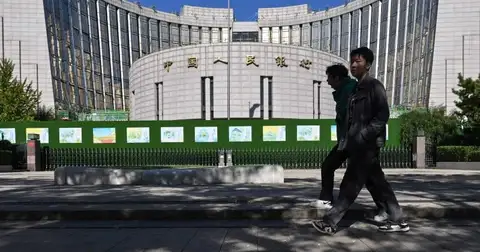
China has closed the door on privately issued yuan stablecoins, and it did so with unusual precision. On 6 February 2026, the People's Bank of China, joined by seven other agencies including the National Development and Reform Commission, the Ministry of Industry and Information Technology and the Ministry of Public Security, issued Notice No. 42 (Yinfa No. 42 [2026]), effective on release. Its central provision: no entity or individual, domestically or overseas, may issue a renminbi-pegged stablecoin offshore without approval obtained in accordance with laws and regulations.
The wording matters almost as much as the prohibition. In one sentence, Beijing asserted that a stablecoin pegged to fiat 'performs some of the functions of legal currency in circulation' — a claim about monetary sovereignty rather than investor protection — and extended that concern beyond its borders to any issuer anywhere in the world.
What the notice says
Notice No. 42 builds on the framework China established in September 2021, when the PBOC and nine other departments issued Yinfa No. 237, banning virtual currency trading and speculation, and cracking down on mining. The 2026 notice explicitly extends those prohibitions to yuan-denominated stablecoins, and reaches further than most observers expected:
- It reaffirms that virtual currencies do not have equivalent legal status to fiat currency.
- It prohibits the offshore issuance of RMB-pegged stablecoins absent explicit approval, applying to domestic and overseas persons alike.
- It brings real-world asset (RWA) tokenisation into scope, defining it as the use of cryptography and distributed ledger or similar technology to convert ownership or income rights in assets into tokens, or into other rights and instruments with token-like characteristics.
The reach — 'domestic and overseas' — is the point. A company incorporated outside China, regulated outside China, issuing offshore RMB tokens to non-Chinese holders, is still addressed. There is no geography left from which the product can be launched permissibly.
Why the timing, and why Hong Kong
Throughout 2025, speculation centred on whether Chinese firms would issue offshore yuan-backed stablecoins from Hong Kong. Major technology groups including Ant Group and JD.com were reported to be preparing for exactly that scenario, and Hong Kong's own Stablecoin Ordinance took effect in August 2025, creating what looked like a licensing on-ramp. The issuance, licensing and marketing of an RMB-referenced token, however, requires Beijing's assent, and none has been granted. Those reported plans should be read as halted unless and until an approval mechanism exists.
Nothing in the notice establishes such a mechanism. There is no published eligibility criteria, no application route and no designated authority named as responsible for granting permission — leaving 'not without approval' functioning in practice as 'not'.
Two rails, deliberately unequal
Set against the prohibition is what Beijing is promoting instead. Reported figures put cumulative e-CNY transaction volume at approximately 16.7 trillion yuan (roughly $2.3 trillion) by the end of November 2025, with hundreds of millions of personal wallets opened. From 1 January 2026, e-CNY balances became interest-bearing, following a framework in which commercial banks pay interest on digital yuan wallets — work that followed a PBOC plan for the next phase of the digital yuan published late in 2025. More banks have since been added as operating institutions.
That combination is strategically coherent. Physical cash pays nothing; most stablecoins, by design or by regulation, pass no yield to holders. An interest-bearing digital yuan offers something neither does, issued by the central bank and distributed through commercial banks. Having removed the private substitute, Beijing improved the state product in the same movement.
The asymmetry is the policy. Private issuance of a currency-like instrument is prohibited; the state instrument carries a yield, official distribution and a clearing guarantee. Hong Kong's stablecoin regime remains credible for tokens that do not reference the renminbi — but anyone constructing an RMB-referenced product now knows the answer before asking.
What it means for tokenisation
Bringing RWA tokenisation into scope is the most consequential line for markets outside crypto. Tokenised funds, receivables, bonds and-equity-like instruments built on distributed ledger rails now sit inside a regulated perimeter, and the definition is broad enough to capture instruments structured to look like something else.
Commentators have read the notice as the first time tokenisation has been brought expressly within Chinese regulatory scope. Whether that produces a licensing pathway for onshore RWA activity or an expansive prohibition will be determined by practice, and probably in Hong Kong first, where tokenised fund and bond pilots have been running under existing securities rules.
The read for companies and investors
For Ant Group, JD.com and the wider fintech sector, the instruction is unambiguous: any digital currency ambition must run through state channels. The e-CNY system is increasingly attractive to participate in — operating institutions, distribution partners and settlement services gain access to a growing network — but strategic independence in money issuance is not available.
For investors who bought the thesis that Chinese technology groups would become stablecoin issuers, the thesis is dead, and the capital that was priced on it should be repriced. For those watching digital currency competition, the more interesting conclusion is narrower: Beijing has decided that the currency layer belongs to the state, and has said so in terms clear enough that no structuring around it is credible.
Sources
- People's Bank of China, Notice No. 42 (Yinfa No. 42 [2026]), 6 February 2026, issued jointly with seven other departments — primary; effective on release; sets the RMB-pegged stablecoin prohibition, the RWA tokenisation definition and its relationship to Yinfa No. 237 [2021].
- PBOC (Nanjing branch, English pages): 'Yinfa No. 42 [2026], Notice of the PBOC, NDRC, MIIT, MPS...' — for the department list and English framing.
- Secondary coverage of the notice, February 2026, for the interpretation that this is the first time RWA tokenisation has been expressly brought into regulatory scope.
- Secondary reporting, December 2025 to August 2026, for e-CNY cumulative transaction volume of around 16.7 trillion yuan to end-November 2025, the interest-bearing framework effective 1 January 2026, and the expansion of participating banks — figures reported in press rather than verified against PBOC statistical releases, and should be treated accordingly.
- Reported rather than confirmed: preparations by Ant Group and JD.com for offshore yuan stablecoins, and the effect of Hong Kong's Stablecoin Ordinance, in force since August 2025.