
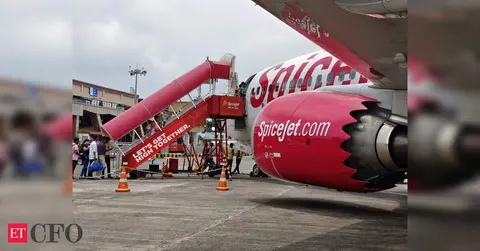
Aircraft lessors have begun repossessing aircraft from SpiceJet after the cash-strapped carrier fell behind on lease rentals. The leasing arm of Industrial and Commercial Bank of China has filed a request with India's Directorate General of Civil Aviation to take back four Boeing 737 Max aircraft it leases to the airline.
The move comes with close to 80% of SpiceJet's fleet grounded. As of Monday the airline was operating roughly 60 flights a day with barely a dozen aircraft, and its maintenance pipeline has suffered for lack of spare parts.
Reporting on the same notice in July 2026 identified the lessor entities as Sky High LXXVIII and Sky High LXXX, Irish-registered special purpose vehicles used by ICBC's leasing arm, leasing four Boeing 737-8 Max aircraft — the standard structure for cross-border aircraft finance.
Why deregistration, not just a lawsuit
An aircraft must be entered on a national register to be operated commercially. Ask the registry to strike it off and the aircraft cannot fly for anyone until it is re-registered elsewhere. That makes deregistration the most practical lever a lessor has: it is faster than suing for arrears and it targets the asset rather than the airline's ability to pay.
Last year India passed legislation intended to make repossession by global lessors materially easier when an Indian carrier defaults, bringing local practice closer to the Cape Town framework of creditor rights over aircraft objects. That cuts both ways, and understanding both edges matters more than the headline.
In theory, predictable recovery lowers the risk premium lessors charge Indian carriers, which lowers their cost of flying. In practice it removes the delay that used to give a distressed airline time to raise money and catch up. Cash stress now converts to lost aircraft, and therefore lost capacity, much faster than before.
Given that most Indian airline capacity is leased rather than owned, this sequencing explains how quickly collapse can follow a liquidity shortfall: the asset base itself is on someone else's balance sheet.
The airline's answer, and where it holds
A SpiceJet spokesperson said the four aircraft have been grounded for more than a year and that repossession will not affect scheduled operations, adding that the airline "continues to remain in discussions with manufacturers and lessors for return to service of these planes." Coverage of the carrier's statement indicated the aircraft had been out of service in connection with engine high-pressure-turbine related manufacturing issues.
Operationally that may be accurate today: you cannot lose capacity from an aircraft you were not flying. But it understates what is given up. Restoring an aircraft is faster and cheaper than sourcing another one, so surrendering these airframes removes the lowest-cost route back to capacity.
It also raises the same question for the lessor. An aircraft grounded by an unresolved engine defect is not an aircraft a lessor can immediately place elsewhere, which means the recovery may remove a future option for SpiceJet without producing much immediate value for ICBC either.
Where the ₹3,000 crore went
The most instructive part of this story is that the airline did raise money — roughly ₹3,000 crore in 2024, the equivalent of near $350 million at prevailing rates — and is nevertheless unable to pay lessors or staff.
The answer is the order of payments. A large share of the fresh capital went to clear statutory dues: goods and services tax, tax deducted at source and provident fund. Those are collected or held in a fiduciary capacity, carry penalties and can attach personal liability to directors, so they are paid first almost regardless of consequences elsewhere.
Lessor rentals, engine and component suppliers and unpaid salaries sit further down that queue. A pilot interviewed said a large portion of employees had not been paid for more than two months, and most had been sent on leave without pay — which is both a humanitarian signal and a reliable indicator of cash exhaustion, since payroll is normally the last thing a company stops paying.
The cascade risk
A single lessor moving first is rarely an isolated event. Operating leases typically contain cross-default provisions, so a defined default under one lease can trigger remedies under others. Once two or three creditors coordinate, the mechanism compounds: each recovered aircraft reduces the fleet, the smaller fleet generates less cash, and lower cash makes the next default more likely.
Repossession also brings its own costs. Aircraft must be returned in agreed condition, with maintenance reserves reconciled and records complete. An operator that has been unable to fund routine maintenance is unlikely to meet redelivery conditions, which can convert unpaid rent into a larger claim for defects and missing records.
Already visible in operations
The strain shows in service data before it shows in filings. In May the airline had the weakest on-time performance and the highest cancellation rate of any domestic carrier. Fleet trackers put the nominal fleet at 53 aircraft with roughly 11 in service, and equity markets marked it down steeply through the period; one July 2026 account cited a fall of about 63% since the start of the year.
These figures should be read as indicators rather than audited facts, since tracker counts and share moves are both snapshots. The consistent direction across all three is what matters, and all three point the same way.
What to watch
- Additional deregistration requests at the DGCA, particularly whether other lessors follow ICBC's lead.
- Whether any settlement is reached on arrears before further aircraft move, since a consensual deferral preserves more value for both sides than repossession.
- Resolution of the engine defect affecting grounded aircraft. Until it clears, neither the airline's return-to-service plans nor the lessors' redeployment plans can be realised.
- Whether salary and statutory arrears are cleared, which is the practical test of whether fresh funding exists.
- Whether the regulator intervenes on route continuity or consumer-protection grounds, as it has done in previous aviation distress episodes.
Sources
- Reporting reviewed in the source article: request by the finance leasing arm of Industrial and Commercial Bank of China to the DGCA to repossess four Boeing 737 Max aircraft leased to SpiceJet; roughly 80% of the fleet grounded; about 60 daily flights flown with barely a dozen aircraft; maintenance affected by lack of spare parts; statement from a SpiceJet spokesperson that the aircraft have been grounded for more than a year and are the subject of continuing discussions with manufacturers and lessors; a pilot's account of salaries unpaid for more than two months and staff sent on leave without pay; use of roughly ₹3,000 crore raised in 2024 to clear GST, TDS and provident fund dues; the poorest on-time performance and highest cancellation rate among domestic airlines in May; and parliamentary passage last year of aviation legislation easing repossession by global lessors.
- Subsequent coverage dated 15–21 July 2026 identifying the lessor vehicles as Sky High LXXVIII and Sky High LXXX, Irish-registered SPVs, leasing four 737-8 Max aircraft; the carrier's statement that the aircraft have been parked in connection with engine high-pressure-turbine related manufacturing issues; Planespotters data showing a nominal fleet of 53 aircraft with 11 in service; an approximately 63% year-to-date share price decline; and reports that at least two lessors had issued default notices to SpiceJet earlier in 2026.
- Note: the identification of the lessor SPVs, the engine-related grounding cause, fleet counts and share price decline come from secondary coverage and have not been independently verified against primary documents. The explanation of deregistration mechanics, Cape Town creditor rights, cross-default cascade risk and the payment hierarchy is the author's analysis.